Fragments of Travel
“Remember what you see before your eyes, fix your gaze on a spot, remember its appearance.”
Before talking about travel, let me start with Hayao Miyazaki. Those who have seen Kiki’s Delivery Service may vaguely remember the house where the black cat doll was delivered — its real-life model stands on the Åland Islands in Finland.
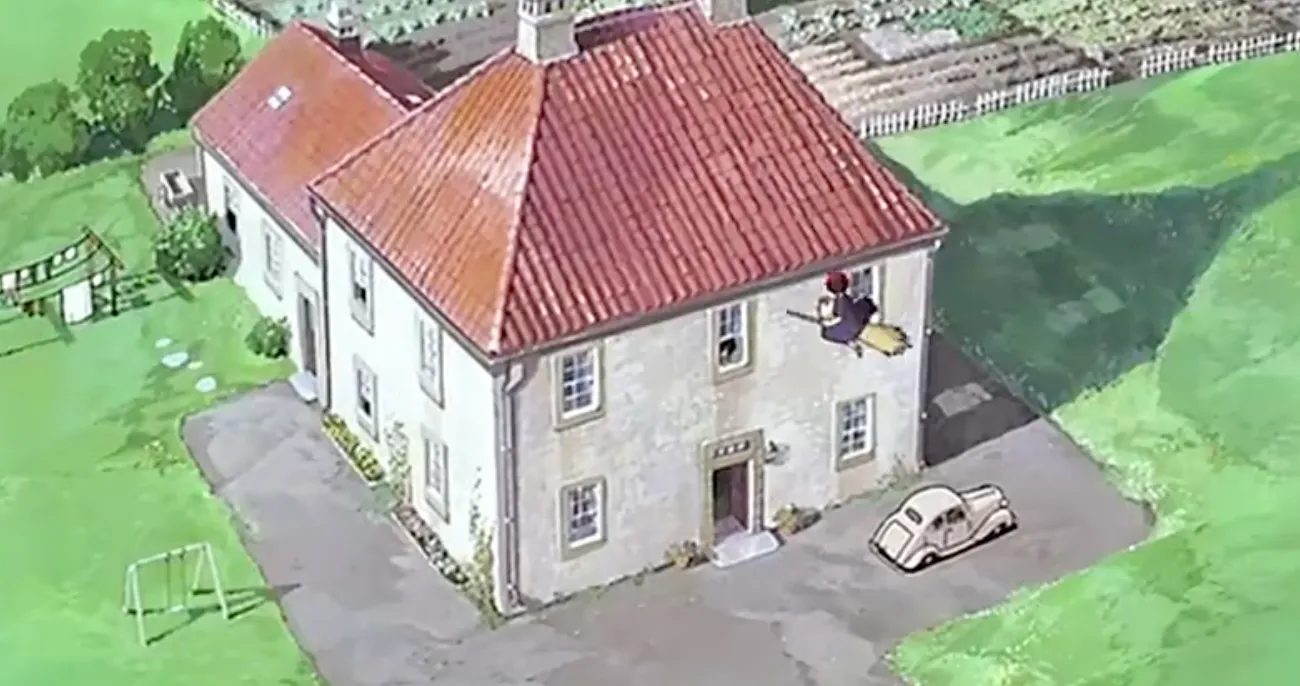
Studio Ghibli producer Toshio Suzuki recalled that when they traveled to Finland in 1988 and came upon the house, Miyazaki stood before it in quiet contemplation. When Suzuki pulled out his camera, Miyazaki snapped at him: “Too noisy.” Not long after they returned to Japan, Miyazaki began working on Kiki’s Delivery Service and drew the house entirely from memory, then asked Suzuki to compare it with the photographs. Looking back on that moment, Suzuki wrote:
When you rely on memory alone — say you noticed ten or fifteen details at the time — after a year or so, you can probably recall only seven or eight of them clearly. So you end up with parts of memory that are sharply defined and parts that have gone hazy. The hazy parts can only be filled in with imagination. In other words, whatever left the deepest impression on you becomes the central element of the work.
And so an original building was born — something photography could never achieve. A photograph can only reproduce reality as it is. Only memory can create something new. I was influenced by this too, and now I try not to bring a camera when I travel. Looking through a viewfinder, you can’t truly observe and absorb the scenery before you. I think it’s more important to see and remember with your own eyes.
This story, which I came across before my departure, served as a reminder to put down the camera more often during the journey and to observe with intention.
What follows are scattered fragments of travel, from the northeast to the northwest, from the central plains to Jiangnan, and onward to the southwest.
Nature
Hiking
Lonely Planet In Xinjiang describes the Kanas loop trail as “top-tier scenery, zero prerequisite experience — your body won’t suffer too much, but your eyes will surely be in paradise.” As a complete hiking novice, I chose the easiest of three routes: Baihaba to Kanas. I handed all my luggage to the guides and their horses, yet the 20-kilometer trek still took a full eight hours. When we finally reached the end, a local worker chatted with my companions, asking where we’d come from and how long we’d been walking. After hearing our answer, he said: “Tourism is just suffering, isn’t it.”
But the scenery along the way made the fatigue and the sun feel worthwhile. When you’re moving fast in a car, the landscape is always gone in a flash. When you’re on foot, everything stays close: forests and grasslands within arm’s reach, the three-dimensional chorus of insects and birdsong that never stops, cattle grazing in scattered ease, herds of horses running free, hunting dogs and sheepdogs of every shape and temperament.
The unexpected delight of those days in Kanas came from a short walk back to the new village from the visitor center. After the tourists had left and the scenic area was nearly empty, the river shimmered under the last light of day. You could sit on the bank, turning over stones and letting the sound of flowing water empty your mind. Walking through the grasslands, the soft light passed through the flowers and grasses like a filter, stretching the shadows of trees long across the ground. As On Walking puts it: “Walking is really a child’s game, letting us marvel once again at the clear weather, the bright sunshine, the lush trees, and the blue of the sky.”
This sense of wonder at nature may not belong only to faraway places — it can appear in the everyday.
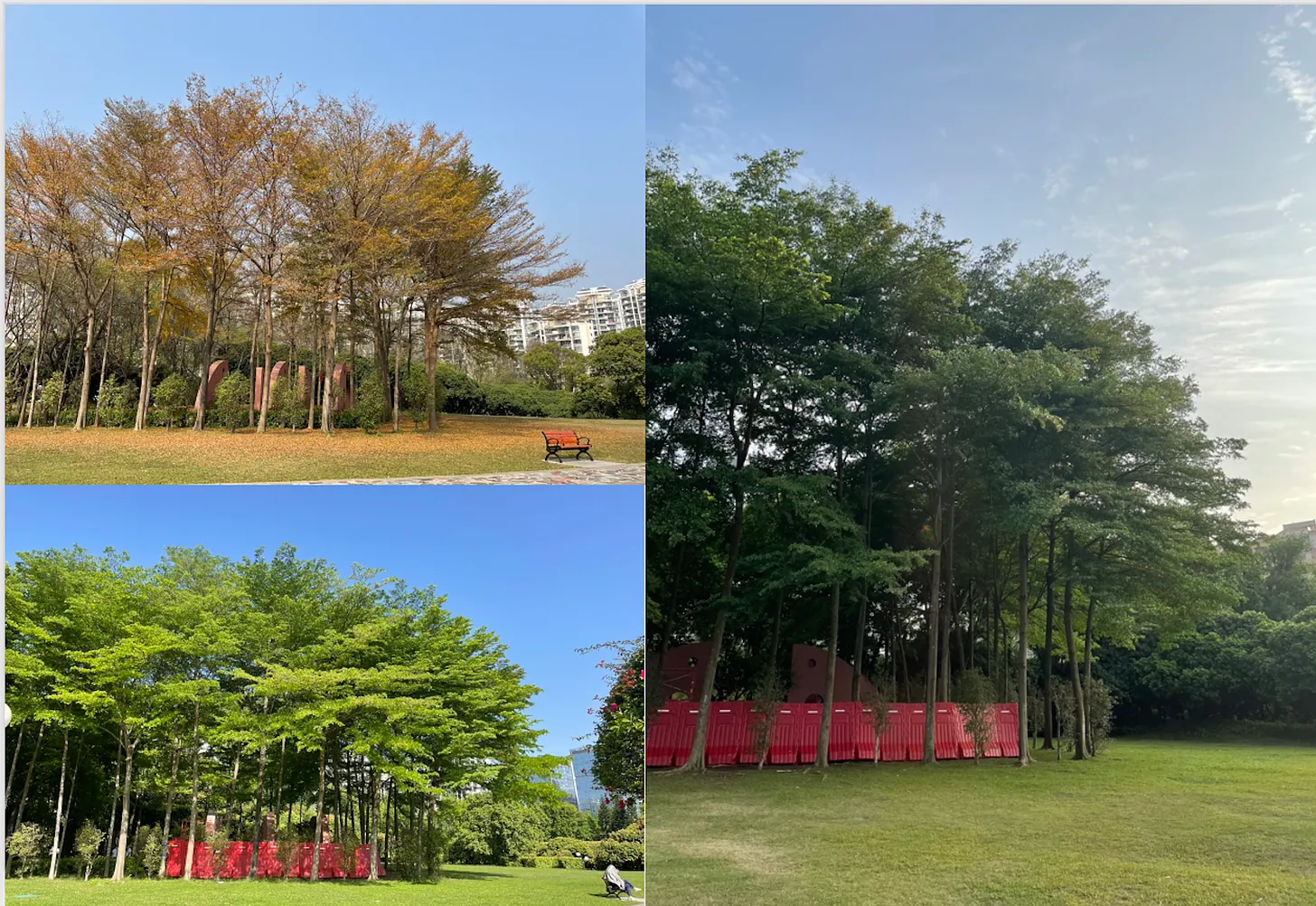
Starting from my fourth summer in Shenzhen, I began going to the park regularly. Once, caught in a downpour in the woods, I heard raindrops strike trees at different heights and ricochet between them before finally reaching the grass below. Accustomed to the flat, monotonous sound of rain on concrete, I realized for the first time that rain could have such depth and texture. In the spring of my fifth year, working from home most of the time, I went to the park on weekends and saw trees full of yellow leaves — only then realizing that in this southern city, autumn comes in early spring. Over the following weeks, I returned and watched those same trees go from bare branches to tender buds to the fresh green of early summer.
Humans and Nature
The trail from Kanas to Baihaba is a well-established route. Clear tire and hoof prints mean you won’t get lost — but they also mean there was once heavy foot traffic and the waste it left behind. The evidence: teammates picked up three full bags of plastic garbage along the way.
It was only later, reading Li Juan’s Sheep Road Trilogy, that I realized how different traditional Kazakh nomads are. To prevent large flocks from stripping the grass along any single path, nomads take different routes each time they move, even if the unfamiliar terrain turns out to be treacherous. When they break camp, they leave nothing behind. The very practice of moving regularly is itself a form of conservation: “They keep migrating, restlessly, so the earth can rest and recover.”
Li Juan also wrote about her mother’s early years gathering wild wood ear mushrooms in the mountains. Later, outsiders flooded in: “Besides picking wood ear, they started digging for codonopsis, cordyceps, garnets — plundering anything that could be sold for money without restraint. The mountain slopes and forest edges were churned into muddy chaos everywhere. … People began sneaking game down the mountain to sell, and some even carried detonators into the mountains to blast fish out of alpine lakes.”
The local nomads, by contrast, would never carelessly pull up the grass their livestock grazed on, nor hunt wild animals for food. Li Juan writes that these nomads “lived in what was probably the closest, purest connection with nature, and such a life demanded the most conscientious, most deeply held awareness of environmental protection — a willingness to live as equals among all things, rather than acting as the master of all.”
Against this backdrop, the garbage strewn along the hiking trail and the shores of Kanas’s Fairy Lake is genuinely embarrassing. For travelers, there is at least the concept of “responsible travel” that Lonely Planet frequently invokes: “Don’t litter: use biodegradable products, and try to bring any non-biodegradable waste generated during rural and outdoor travel back to the city for proper disposal.”
Culture
Citywalk has to rank as my favorite way to explore. Step by step, it builds a three-dimensional reality from the flat plane of a map, and traveling on foot always reveals unexpected sides of a destination. As Why We Walk puts it: “A stroll is the best way to understand a city. From a car or bus, you cannot feel a city’s mood. Walking lets you take in all the dust and glory of urban life: the smells, the sights, the sound of footsteps on the sidewalk, the jostling of bodies, the flicker of streetlights, and the fragments of conversation from passersby.”
Ethnicity
In a small city in southern Xinjiang, waiting for the night market to open, I followed the sound of music to a local gathering — a kind of square dance, but nothing like the exuberant, exercise-oriented ones I’d encountered in mainland China. Here, the pavilion’s center was the dance floor, ringed by layers of spectators. The dancing was more like a gentle form of socializing: people shifted freely between dance moves with the rhythm of the music, bowing to their partners at the end of each song before turning to invite someone from the crowd. And if you preferred, you could simply dance on your own.
In the old city, where Uyghurs make up the majority, the handful of Han tourists always drew special attention. Elderly men would step aside from the front row, gesturing for us to move forward. During breaks between songs, we were repeatedly invited onto the stage. The tourists who eventually joined were given patient, attentive guidance by their dance partners — though no matter how hard they tried, it was nearly impossible to replicate the effortless grace that seemed innate to Uyghur dancers. A bonus: the next day at the Yarkand Palace, watching a Twelve Muqam performance, I realized the most animated dancers from the night before were all performers on the stage.
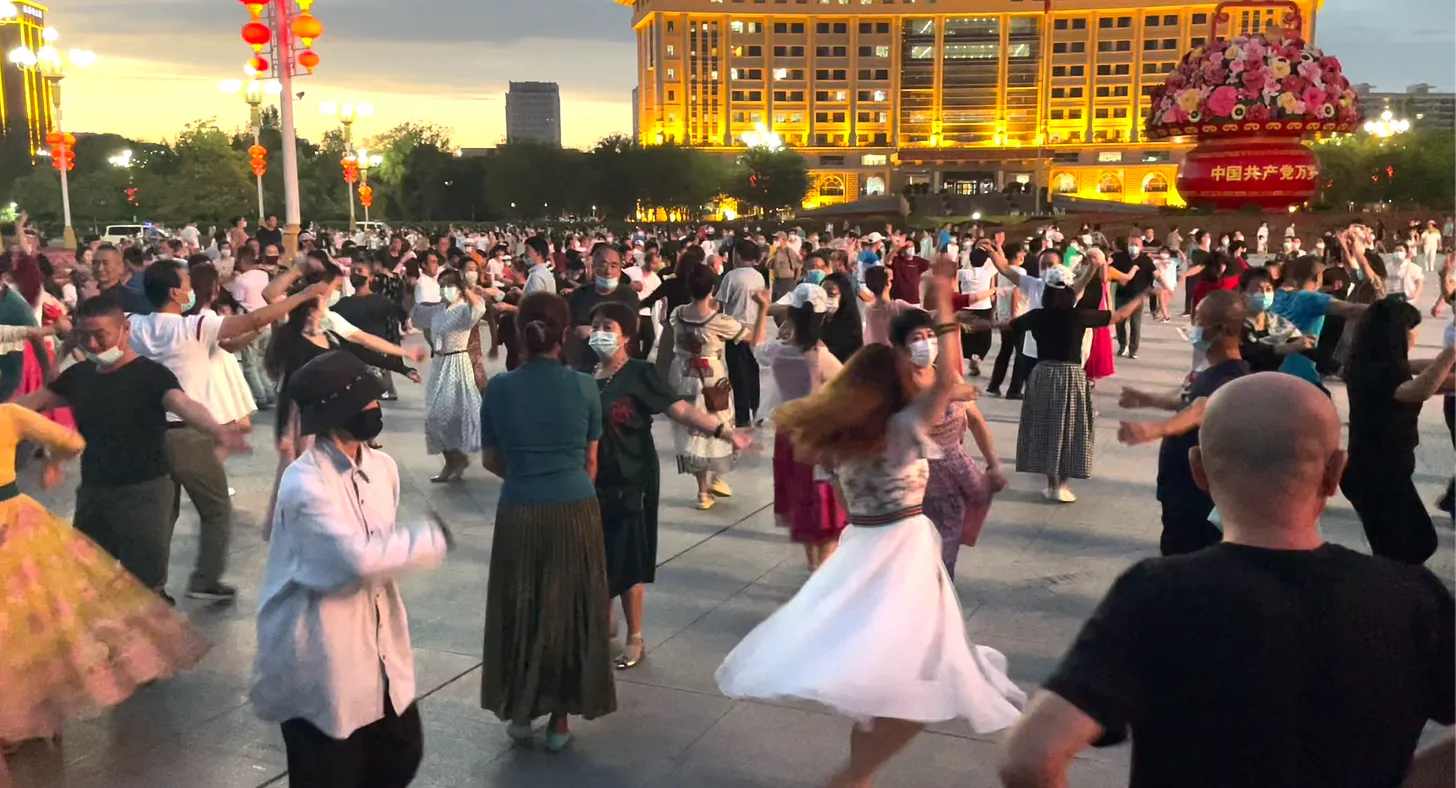
The Jingpo square dance in Mangshi felt more like a simplified version of the grand Munao Zongge festival. The lead dancer wore white and carried a long sword-shaped prop; the women waved fans behind him. Following them in two columns were people of all ages: a grandfather with bandages around his ankles, a grandmother with a curious toddler peeking over her shoulder, a visibly pregnant woman holding the hand of a three-year-old. All of them followed the lead dancer’s cues, changing formations and movements with the music, and breaking into unified shouts at certain beats.
Li Juan, describing Kazakh nomadic dance, wrote: “Dancing is instinct — taking control of your own body, showing the beauty you want to show, getting to know yourself, understanding yourself, discovering yourself. Dancing is an act of self-discovery.” Watching these free and uninhibited ethnic dances, I always felt a kind of infectious joy — which is probably why the Uyghurs wanted to pull tourists into the dance, and why, watching the Jingpo, I felt the urge to join in.
Religion and Belief
During a citywalk in Xi’an, I arrived at the mosque just as prayers were about to begin. A tourist was chatting with an elderly worshipper, who patiently explained the prayer rituals, the purpose of the ablution room we’d passed, and the clock hanging in front of the prayer hall.
Just before prayers began, a boy of about six or seven ran inside. His bright yellow cartoon slippers, kicked off at the entrance, stood out conspicuously among the rows of grown men’s dark gray shoes. After prayers ended, the white-capped, white-robed worshippers dispersed quickly. In the brief silence that followed the commotion, the mosque was left with only the imam watering flowers in the evening light and a small orange cat darting about.
For them, praying five times a day folds naturally into everyday life, and the religion continues to be passed down through the participation of the young.
Compared to religion, what is more commonly seen in folk life is belief. As Chiang Hsun put it:
Belief is a rather broad term — strictly speaking, it and religion are two different systems. Religion has a rigorous definition, a complete framework, starting from Genesis: how the universe was created, where life comes from and where it goes… the practices and precepts are fully developed. There are actually very few things in the world that can truly be called religions — Buddhism, Christianity, Islam, and a handful of others. But beliefs are far more numerous: Mazu, Guan Gong — these are not formal religions, yet they are beliefs.
In Yunnan, traces of belief are everywhere. In Dali’s Bai ethnic villages: the local deity temples, the Kuixing Pavilion still used by students praying before exams. In homes: reserved incense holders, Jiama paper burned on ritual occasions — woodblock prints of the spirits of mountains and forests, the thunder god, the earth god. And across ethnic groups: creation epics passed down through oral tradition to this day — the De’ang people, for instance, believe they are the descendants of tea leaves.
The poet Yu Jian described the beliefs of Yunnan’s ethnic groups as “animism”: “According to Qing dynasty records, over 140 distinct ethnic groups were documented in Yunnan. They believe all things have spirits. The land belongs not only to humans but also to gods — and these gods are not a single idol, but nearly everything beyond humankind: forests, rivers, plants, wild animals… all part of a vast spiritual system.”
Thinking of the Kazakh nomads’ self-imposed restraints — never digging up grass, regularly moving camp — alongside the “all things have spirits” belief of Yunnan’s peoples, I wonder whether both amount to a kind of reverence that grows naturally from faith in nature. This is perhaps what Chiang Hsun meant when he said that belief lets a person “know there is an inconceivable force above, guiding them, and it teaches humility.”
Later, in a Jiama shop in Weishan, chatting with the elderly owner, the first woodblocks he brought out to show me were the God of Wealth and the deity of good encounters (the one who governs romantic fate) — apparently the gods he thought most fitting for a pragmatic outsider. :)
The Philosophy of “Enough”
What I felt most in Dali’s citywalk was leisure. In narrow alleys, when a car was stuck behind an elderly person, the driver didn’t lean on the horn — he simply followed behind at the old person’s pace.
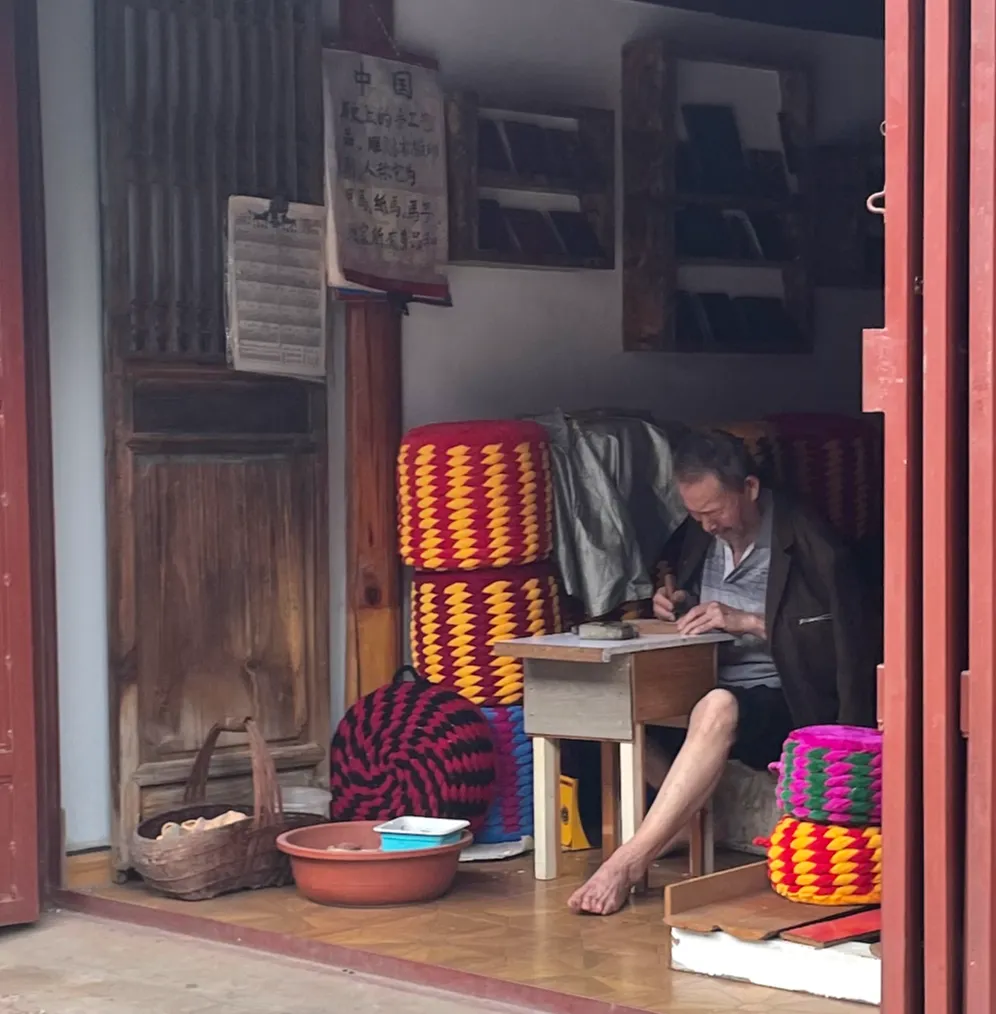
Once, sheltering from the rain by the roadside, I started chatting with a woman selling rushan nearby. With few tourists on a rainy day, a group happened to walk past while she went to fetch her lunch. When I mentioned it, she said: earn what you can, let go of what you can’t — just let nature take its course. Not a trace of regret for the missed opportunity.
Then there were the Dali shop owners who close on holidays and shut early when it rains, to the annoyance of a fellow traveler who complained about their whims inconveniencing tourists. In the small town of Weishan, the stubbornness was even more apparent: popular noodle shops only served until they sold out, rarely staying open past noon, leaving day-trippers to find closed doors. From a conventional economic standpoint, hiring more staff, extending hours, expanding the shop — all of it would be the natural thing to do to make more money. But they simply don’t.
Chiang Hsun, in Ten Lectures on Life, writes about the Parisian philosophy of “enough”:
I think the greatest joy of returning to Paris each time is finding so many people’s quiet confidence. On every corner there is someone’s confidence — calm, unhurried, as if they don’t want to disturb anyone.
Take the ice cream shop owner, for instance. He sells dairy-free ice cream, and for decades there has always been a long line outside his door. But he would never think of opening more locations. He seems to have a feeling of “enough” — and that “enough” is a difficult philosophy: I am happy doing this, and everyone who eats my ice cream is happy too, so — enough.
I think this philosophy of happiness lives in these stubborn shop owners too.
Citywalk Fragments
- In Kashgar’s old city, I heard voices coming from above. Looking up, I saw children from two households chatting across the alleyway.
- I stumbled upon an office bearing the sign “Yangzhou Bathing Association” — evidence that the city’s traditional pedicure trade was still going strong.
- On a village wall in Mangshi, I saw a roster dividing funeral duties into groups — neighborly cooperation required to handle the workload of a burial. I also noticed many names that were simply a surname followed by a number: Yang Two, Xian Four, Jin Five… probably Han Chinese names reported by birth order when identities were first registered.
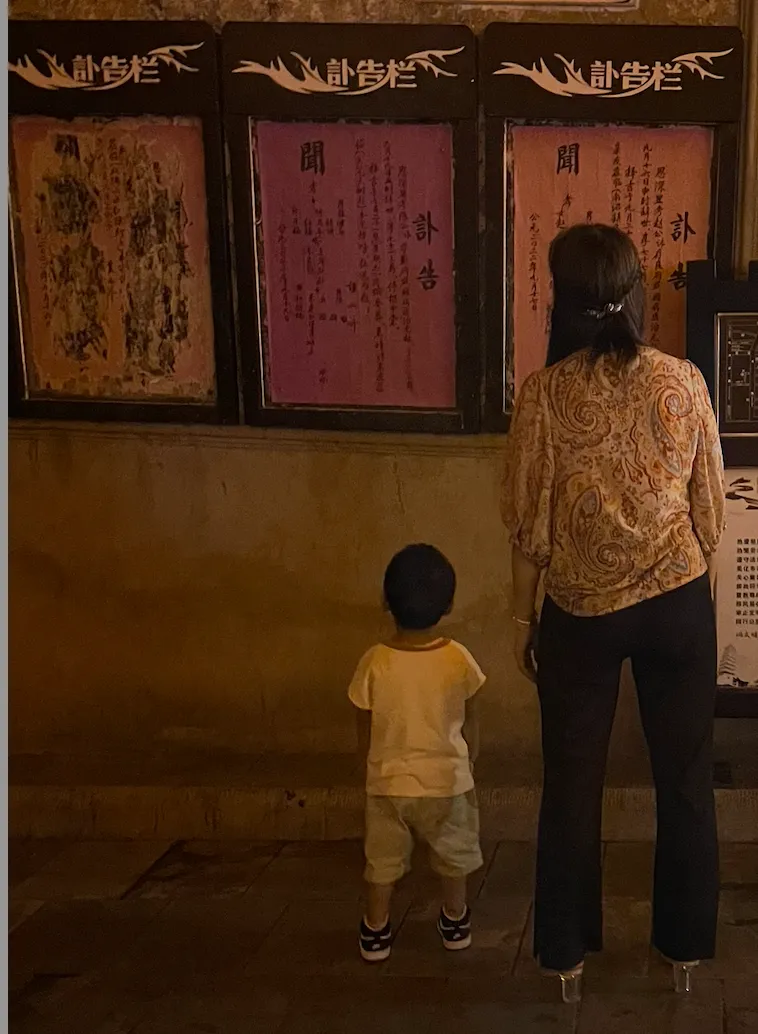
- In Weishan, when someone dies, an obituary is posted on the main street’s notice board. Couplets about the death are posted on the family’s door. Three years after the death, a couplet marking the end of mourning is added. Near the city gate, the coffin shop sits right next to bustling snack stalls — “this living ancient city never seems to shy away from talking about death.”
And there were the strangers I crossed paths with and talked to briefly: the Shanghai woman who taught herself to invest from scratch, built an annual travel fund, went on loaded treks whenever she could, and had just come back from learning to ride horses in Inner Mongolia. The seventy-year-old man who followed his parents to Xinjiang in the 1950s. The Shenzhen sister road-tripping across Xinjiang with her son, cobbling together shared rides. The Beijing woman who quit state media because the news was getting more and more pointless and she couldn’t stand the “improvement meetings.” The Heilongjiang aunt who retired before her husband and set out traveling alone. The Shenzhen uncle who retired early, spent years backpacking abroad just before the pandemic, and now lives in a small town writing up his African travelogues.
But more often, it was everything I witnessed as a bystander. Li Zishu, author of The Flow of the Land, once said she would be the only person in the subway car not scrolling on her phone — because guessing at the lives of those around her was more interesting. She would imagine their circumstances and backgrounds. During my travels, I also began consciously putting down my phone to “read” the people around me. Here are some of these field observations:
Waiting in Urumqi’s Consulate Lane for lamb naan to come out of the oven. A man kneaded dough in a back room while a boy tended the naan pit, collecting money and handing out napkins on the side. I arrived earliest, then more people came, until the crowd around the pit became a shapeless ring with no clear queue. When the naan was ready, I noticed an elderly couple ahead of me and was quietly preparing to let them go first. But a nearby Uyghur elder said something in Uyghur to the boy, who then asked how many I wanted and handed me the naan first — a small, unexpected kindness. The lamb naan, by the way, was excellent.
Queuing at the mahua oil tea shop, an old man muttered that only tourists came to eat here. The owner, busy making oil tea, overheard and was not having it: “That’s because it’s your first time.” She pointed to a woman standing off to the side, not in line: “She lives on the street right there. She comes every day to take away three portions.” A shop that had become a tourist hotspot, still wanting to prove it was loved by the neighborhood.
Resting near the restrooms at Canglang Pavilion, a mother insisted that her daughter — who looked at least eight — go to the toilet. The girl said several times, with mild defiance, that she didn’t need to go. The mother, packing up their things, kept saying with a perfectly straight face: “Just try — you might need to after all.” Later, on a shared ride, I chatted with a fellow traveler — an aunt who mentioned her daughter had loved drawing when she was young. “But her father and I didn’t understand it, so every time we saw her drawings, we tore them up. She ended up studying something else in college.” I felt sad for the little girl at the pavilion, and for the stranger whose drawings were torn away.
At the high-speed train station, waiting in line to board, a girl on the phone was excitedly telling a friend: “I’m getting married! There’s this guy I’ve known for two years. We were chatting recently and he mentioned he’s been pressured to marry too, and my family’s been pushing hard, so we just decided to go ahead. Next time I’m back, we’ll register.” The friend must have asked what the guy was like, because the girl said: “He’s been in the army for nine years — he must be responsible.” A snapshot of contemporary marriage, expedited.
These observations never fit into a tour group’s precise itinerary. But in the course of wandering, you keep stumbling upon encounters that give you a chance to glimpse a more vivid, more human version of a destination.
(About Xinjiang: I also think of what lies beyond the tourist’s vantage point — the head of the economics department at Johns Hopkins University, who documented his experience renewing his Xinjiang passport on Weibo. What he and others like him go through is perhaps the Xinjiang that locals actually live in.)
Architecture
In his twenties, Tadao Ando traveled to Europe to study buildings, from the Pantheon in Rome to Le Corbusier’s Chapel at Ronchamp. Reflecting on the journey later, he said: “Even with the same knowledge, the depth you gain from reading abstract words is entirely different from what you gain through firsthand experience.”
This kind of understanding that reading alone cannot provide is perhaps most pronounced in architecture. The play of light and shadow, the texture of materials, the height of ceilings, the smell of the air — these spatial qualities that buildings create demand that you be physically present.
How is space created? Beyond the technical know-how we associate with construction, Wang Shu writes in Building a House that building also requires sensibility. “To build a house is to build a small world,” and “building a world depends, first and foremost, on one’s attitude toward that world.” The Chinese garden is the quintessential example of a space built with such an attitude.
Suzhou’s gardens were mostly built within the bustle of the city, earning them the name “urban forests.” But after the careful selection of site, the shaping of hills, the arrangement of water, and the planting of trees, garden makers were never simply recreating nature within a “forest.” From the overall layout (like the Yi Jing cosmology embedded in the Couple’s Retreat Garden) to the naming of halls and pavilions (like “With Whom Shall I Sit” in the Humble Administrator’s Garden), the gardens carry the owner’s sensibilities and philosophy. This is what Wang Shu means by “the garden maker, the garden dweller, and the garden growing and evolving together.”
As a visitor, how do you truly experience the ingenuity of garden design? As Yu Kuan, author of The Garden Maker, puts it: “A garden provides its owner with a place to both wander and dwell — not a park to be hurried through and left behind.” And as Wang Shu writes: “A garden is not merely a visual object but a bodily experience. The garden owners of old lived in their gardens for years on end, and through that slow passage of time, life took on flavor.”
A garden asks you to slow down. Sit in a pavilion and take in the borrowed scenery, the carefully placed rocks and plants. Feel with your own body the twists and turns of the garden paths and rockeries. Watch the framed views shift as you move. Notice how the light and shadow through lattice windows change with the angle of the sun. And savor the qualities hidden in different seasons and weathers: the sound of rain on banana leaves, the fragrance of lotus in summer, the scent of osmanthus in autumn.
Each garden, of course, has its own character. At the Lingering Garden, the three contractions and expansions of the entrance corridor create a rhythm of darkness and light. In the Emerald Exquisite Hall at Canglang Pavilion, walking back and forth a few times reveals a dim, almost fractured space that seems to decompose around you. At the Art Garden’s Qin Lu, Boston ivy grows freely up the tall courtyard walls alongside Taihu stones. At the Garden of Ecstasy, the narrowing of the Crane Step Beach draws the eye outward, extending the sense of water beyond its banks.
This kind of patient exploration applies not only to gardens but to any work of art that demands patience. Harvard professor Jennifer L. Roberts describes an art history assignment in which students must choose a painting for a paper — but before doing any research, they are required to sit before the painting for three hours. Roberts believes that only by truly spending time with a work can you discover its details. Looking at A Boy with a Squirrel, it took her 9 minutes to notice the resemblance between the folds of the squirrel’s belly and the boy’s ear, 21 minutes to see that the fingers holding the chain were the same diameter as the glass of water, and 45 minutes to discover that the seemingly random folds of the curtain echoed the shapes of the boy’s eyes and ears.
In The Power of Patience, Roberts argues that people tend to assume vision is direct, simple, and instantaneous — but in any work of art, the details, the order, and the relationships all require time and patience to perceive.
By the way: if your main reason for visiting a garden is the architecture, don’t waste money on night tours. There are far better venues for Kunqu opera and Pingtan storytelling.
Other: Planning, Packing, and the Meaning of Travel
On Planning
Chunyin recently shared his process for making travel itineraries — broadly similar to mine: review bookmarked travel guides and Lonely Planet, get a general sense of the place, mark accommodations, attractions, and restaurants on a map, then arrange the schedule and make necessary reservations.
(When will Amap support different icons for accommodations, food, and attractions like Google Maps does?)
One surprise of this trip was how effective Xiaohongshu turned out to be as a search engine. It could surface details like museum ticket release times — information not available on official channels but essential when traveling — far better than the flood of stock-market and cosmetic-surgery ads that dominate Weibo’s search results. (That said, comparisons have shown that Xiaohongshu has some of the strictest content moderation among platforms. The content that the platform chooses to keep and recommend inevitably shapes what creators produce — which is really just Jonathan Blow’s observation that “the medium is the message”: the medium itself shapes the quality of the content.)
On Packing
Before leaving, I happened to see a post by Vitalik Buterin (yes, the Ethereum founder) about his one-bag travel setup, and browsed Reddit for tips from experienced backpack travelers. The most useful takeaways from my own experience: (1) Layer like an onion — based on the destination’s weather, prepare a quick-dry base layer, an insulating layer, and a windbreaker, then pack them in compression bags. (2) Optimize for volume — for example, use a single universal charger for everything from your toothbrush to your laptop. (3) Establish a travel routine — Vitalik’s is drinking tea every day.
Overall, I didn’t optimize to the extreme. The whole trip was a 20-inch suitcase and a backpack (with a stop back in Shenzhen midway to repack — thanks to Rui’er for putting me up). Later in Dali, I met a woman from Sanya who had also been traveling for a long time, with her eight-year-old child, carrying about the same amount of luggage. It made me realize that when you’re on the road, you need far less than you think. Maybe someday I’ll manage true one-bag travel. :)
The Meaning of Travel
If I must sum it up, the main significance of this trip was having an abundance of free time.
Just before starting university, a Chinese teacher from the class next door wrote on his blog: when this longest summer vacation is over, ask yourself whether you truly cherished the freedom you once longed for.
During this longest vacation of my adult life so far, this arguably luxurious freedom was spent getting close to nature, absorbing culture, and thinking about architecture. But more importantly, throughout the process of planning and traveling, I was in a long, continuous conversation with myself — asking, step by step: what do I want? What can I let go of? In my interactions with the world, what should I pay attention to, and what should I ignore?
The end of this journey does not mean the end of those reflections.
According to psychologist Daniel Kahneman, our lives contain an experiencing self and a remembering self. People tend to romanticize their memories after the fact — even the less-than-pleasant moments fade.
Beyond the photogenic, anecdote-worthy highlights, the trip naturally had its share of unpleasant details: sweating profusely while touring gardens in 40-degree heat, overnight sleeper cars where middle-aged men roamed the aisles trying to swap bunks, museums where poor pacing left me completely drained, minor injuries and illnesses to deal with — plus constantly adapting plans around local pandemic policies.
Beyond that, travel itself has been somewhat over-romanticized. Going somewhere far away, in and of itself, solves nothing. And an obsession with ticking off places is unlikely to produce intellectual growth.
As The Invitation to Linguistics puts it:
Unless a person knows what to look for in experience, that experience often proves meaningless. Many people set great store by experience… They think: “I don’t want to just sit around reading books — I want to go out and do things. I want to travel, I want experience.” But when they actually venture out, the experience they gain often benefits them not at all. They go to London, yet all they can remember are the hotels they stayed in and their tour group. They visit China, yet their entire impression of the country is: “There were a lot of Chinese people.” They may have served in the South Pacific, yet all they recall is how bad the army food was.
Rousseau considered travel a vital part of Émile’s education — but only because he had first given Émile the freedom and the capacity to observe, and sent him off with a purpose to explore.
Yet even if we don’t know what to look for in our experience, we can still try, like Miyazaki and Suzuki, to put down the camera, observe with our eyes, and feel with our hearts:
Remember what you see before you. Fix your gaze on one spot. Remember how it looks.
Watch it when it snows. Watch it when the grass first grows. Watch it in the rain.
You must feel it, remember its smell, walk back and forth to explore the texture of the rock.
Then this place will stay with you always.
When you are far away, you can call on it, and whenever you need it, it will be there — in your heart.